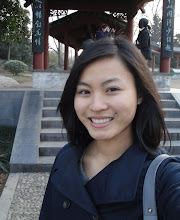
After returning to Shanghai, I had one week before heading back to Phoenix, and it flew by in such a blur. I honestly wasn't mentally ready to leave. I've come to the opinion that the problem with plane travel is that there'e no "travel" involved--one minute, I'm in an air-conditioned airport in Shanghai, listening to Chinese chatter. A few (well, 11) hours later, I'm in an air-conditioned airport in Vancouver, surrounded by English. Very disorienting.
Overall I am glad to be home, although all those pesky things I've put off thinking about while in China have all leapt up on me. I have mini panic attacks when I do grad school research--there are so many things to think about and consider, like applications, GREs, funding, worry about my own qualifications and/or lack thereof. Then there is the usual parental pressure which makes things even harder. I almost want to just work instead or move to a third world country where no one can trace me. But immediate concerns are finding a place to live (thank goodness I already have two great friends to be roommates with) and finding a job for this year.
In high school, I decided to study architecture only in my last year. I don't remember what it felt like to make that decision against my parents' very strong wishes for me to go into medicine/engineering/something befitting a star Chinese-American pupil. Was I merely rebelliously defiant? Mostly apprehensive? I've completely fallen off the ambitious, self-glorifying track but I'm not sure where to get back on. Join the ranks of Starbucks baristas? They sure seem happy about working there... I don't think I've lowered my standards of success, but rather I just see success differently now.
Showing posts with label introspectus. Show all posts
Showing posts with label introspectus. Show all posts
7/13/2010

5/07/2010
Smells
I got my wish: summer is here. With the heat and mugginess come the smells. During the winter, to quote a professor, "all the shit is frozen", but now when i walk down the street, all the familiar and often unwelcome smells are back. Just walking home, I smell fried dough (油条), sichuan peppercorns, and 包子. And of course, that unpleasant street smell that is composed of garbage, exhaust fumes, and children's (and probably adult's) urine. Although many China smells are bad, I kinda like it…it's smells like a place where people live. Phoenix smells like desert and concrete, which I also like, but it's mostly sterile.
Smell is especially evocative for me. I've been visiting China since I was young, and some of my strongest memories are the smells. Sometimes I'll encounter them in the States too--like one I can only describe as "construction", which immediately brings me back to my grandparents' apartment complex--and when I do come across them in a different environment, I literally stop in my tracks in confusion. There's also that musty, metro station smell that I find sometimes in the garage in the summer.
One thing I really pay attention to when traveling is scent. Korea was very interesting, because the smells there really transported me out of Asia. For one, a lot of people wore perfume or cologne. Instead of Chinese BO and Chinese old man breath (anyone who knows old Chinese people knows what this is like…), I was surrounded by smells I typically associate with America. I smelled cologne that brought me back to high school prom and waterfront walks in Annapolis. I smelled perfume that reminded me of getting ready for a night out on Mill Ave. But there were plenty of Korean smells too: I remember donuts in the metro stations, fish markets, pickled vegetables, sterile museum.
And anywhere in the world, the combination of beer and chain-smoker breath…decidedly unsexy, but it still makes my heart squeeze painfully, even three years later.
I wonder if anyone else pays as much attention to smell. It probably explains why delicious food is so important to me.
Smell is especially evocative for me. I've been visiting China since I was young, and some of my strongest memories are the smells. Sometimes I'll encounter them in the States too--like one I can only describe as "construction", which immediately brings me back to my grandparents' apartment complex--and when I do come across them in a different environment, I literally stop in my tracks in confusion. There's also that musty, metro station smell that I find sometimes in the garage in the summer.
One thing I really pay attention to when traveling is scent. Korea was very interesting, because the smells there really transported me out of Asia. For one, a lot of people wore perfume or cologne. Instead of Chinese BO and Chinese old man breath (anyone who knows old Chinese people knows what this is like…), I was surrounded by smells I typically associate with America. I smelled cologne that brought me back to high school prom and waterfront walks in Annapolis. I smelled perfume that reminded me of getting ready for a night out on Mill Ave. But there were plenty of Korean smells too: I remember donuts in the metro stations, fish markets, pickled vegetables, sterile museum.
And anywhere in the world, the combination of beer and chain-smoker breath…decidedly unsexy, but it still makes my heart squeeze painfully, even three years later.
I wonder if anyone else pays as much attention to smell. It probably explains why delicious food is so important to me.
4/21/2010
Mr. Jin and Ishmael?
I complain a lot about inane conversations at work, but today was really good.
My boss, Mr. Jin, sat down to show me some pictures of some villas in the old Hui style. Courtyard houses were very common, composed of simple rectilinear blocks; the different pathways provided variations in space. There were rules about how many doors, windows, pillars, rooms, etc one could have and only the emperor was allowed to have decorations and frivolities in design.
Southeastern Anhui is a mountainous region and many villages lived in isolation from the kingdom. It was also an area of rich Hui merchants and because of the isolation, they often worked their way around design rules. Instead of 9 fancy pillars in the hallways, they'd make three big pillars and then ring each one with three, decorative pillars connected via delicate latticework. Instead of plain beams, they'd carve flowers and clouds onto them and hope that no officials would happen to drop by and look up at the ceiling. Back then, liberties with design meant beheading so these guys were gutsy.
(Huizhou was at its economic and cultural peak during the Song dynasty. The Cultural Revolution pretty much finished off--literally--the remaining merchants and landowners, and now Anhui is very poor.)
Then 100 years ago, Western influence came into China, bringing with it Western ideas of design and technology. Stone and concrete began replacing wood, which was now a limited resource. Furthermore, the concept of city began to change. Before, it had been a highly feudal setup, with a city being a king surrounded by establishments, which was surrounded by farms. Gradually, people began packing in together into smaller and smaller spaces, due to many reasons such as industrialization. This is a process we are continuing today. Shanghai has about 20 million people. I live in a box 200 feet off the ground.
Mr. Jin deplored this condition of living. He says the courtyard house, where people spend their time outdoors and under the sun, is the natural way for people to live. Xiao Yan then pointed out that only in the modern concept of city can there be technological progress. Marketplace of ideas, division of labor, etc.
Mr. Jin, "That's true. But the traditional living style lasted thousands of years. It worked. How long do modern cities last? Already we can see it's a failed model. You can argue progress is important for society, but the old way of living is important for people. "
This is the most beautiful thing I've heard so far in China.This argument may not make sense to some people, but anyone who has read Daniel Quinn's book Ishmael will understand completely.
Xiao Yan said, "I think the old ways perished because they weren't efficient at all. Survival of the fittest applies to ideas too."
Mr. Jin: "What we have today isn't survival of the fittest. Rather, it's the survival of whoever can eliminate the weakest the fastest. In nature, both the strong and the weak find a way to exist, for how else can we have diversity in the world? Diversity applies to culture as well."
I wanted to hug him. My boss is awesome. I feel like Mr. Jin may have also read Ishmael.
There is no way I can go into Quinn's philosophy briefly, but basically, humans currently live in a way that is not in accordance with nature's laws, which is why we are destroying ourselves and the planet. No amount of technology will change that. We have to realize that a way of life that works is one that lasts--what doesn't work is putting all of our energy in developing sustainable cities, making recycling programs, putting little bandages on huge problems in order to maintain our current way of life. As well-meaning as people are, I still shake my head at slogans like, "Better city, better life."
Well this blog entry got a little out of control…but Ishmael is one of the most important books I have read. Combine it with discussions about design and I am super excited.
My boss, Mr. Jin, sat down to show me some pictures of some villas in the old Hui style. Courtyard houses were very common, composed of simple rectilinear blocks; the different pathways provided variations in space. There were rules about how many doors, windows, pillars, rooms, etc one could have and only the emperor was allowed to have decorations and frivolities in design.
Southeastern Anhui is a mountainous region and many villages lived in isolation from the kingdom. It was also an area of rich Hui merchants and because of the isolation, they often worked their way around design rules. Instead of 9 fancy pillars in the hallways, they'd make three big pillars and then ring each one with three, decorative pillars connected via delicate latticework. Instead of plain beams, they'd carve flowers and clouds onto them and hope that no officials would happen to drop by and look up at the ceiling. Back then, liberties with design meant beheading so these guys were gutsy.
(Huizhou was at its economic and cultural peak during the Song dynasty. The Cultural Revolution pretty much finished off--literally--the remaining merchants and landowners, and now Anhui is very poor.)
Then 100 years ago, Western influence came into China, bringing with it Western ideas of design and technology. Stone and concrete began replacing wood, which was now a limited resource. Furthermore, the concept of city began to change. Before, it had been a highly feudal setup, with a city being a king surrounded by establishments, which was surrounded by farms. Gradually, people began packing in together into smaller and smaller spaces, due to many reasons such as industrialization. This is a process we are continuing today. Shanghai has about 20 million people. I live in a box 200 feet off the ground.
Mr. Jin deplored this condition of living. He says the courtyard house, where people spend their time outdoors and under the sun, is the natural way for people to live. Xiao Yan then pointed out that only in the modern concept of city can there be technological progress. Marketplace of ideas, division of labor, etc.
Mr. Jin, "That's true. But the traditional living style lasted thousands of years. It worked. How long do modern cities last? Already we can see it's a failed model. You can argue progress is important for society, but the old way of living is important for people. "
This is the most beautiful thing I've heard so far in China.This argument may not make sense to some people, but anyone who has read Daniel Quinn's book Ishmael will understand completely.
Xiao Yan said, "I think the old ways perished because they weren't efficient at all. Survival of the fittest applies to ideas too."
Mr. Jin: "What we have today isn't survival of the fittest. Rather, it's the survival of whoever can eliminate the weakest the fastest. In nature, both the strong and the weak find a way to exist, for how else can we have diversity in the world? Diversity applies to culture as well."
I wanted to hug him. My boss is awesome. I feel like Mr. Jin may have also read Ishmael.
There is no way I can go into Quinn's philosophy briefly, but basically, humans currently live in a way that is not in accordance with nature's laws, which is why we are destroying ourselves and the planet. No amount of technology will change that. We have to realize that a way of life that works is one that lasts--what doesn't work is putting all of our energy in developing sustainable cities, making recycling programs, putting little bandages on huge problems in order to maintain our current way of life. As well-meaning as people are, I still shake my head at slogans like, "Better city, better life."
Well this blog entry got a little out of control…but Ishmael is one of the most important books I have read. Combine it with discussions about design and I am super excited.
4/19/2010
Identity
This past year in China has often seemed like a war of attrition on my nerves--how long can I survive in a foreign country without facebook and Mexican food? Of course I've gained a lot during my time here, such as a broader world view, and most things that I've been deprived of can easily be replaced, such as cheese enchiladas. However, there is one thing that is irrevocably lost and that is my sense of identity.
I'm sure every ABC (or child born to immigrant parents) at some point or another grapples with the feeling of not quite belonging to the society he/she grows up in. While I never experienced racism growing up, I was always acutely aware of my Chinese heritage. I know this sensitivity was largely due to my parents' influence and I still clearly remember some of my dad's lectures about how we had to study hard because it was the only way we could make it in a foreign society. My parents made sure that my sisters and I knew that deep, deep, deep down we were Chinese and that no white American would ever look at us and see otherwise. We had to be proud of our Chinese heritage, learn how to speak Chinese, and in the best case scenario, have Chinese kids. This constant reiteration of our Chinese-ness led to me thinking, "Hey, some of my values may be American, but I'm Chinese and my homeland is China." It made me uncomfortable saying, "I'm American." It made me think that studying abroad in China would be an easy transition.
After living in China for almost a year, I see how wrong I was. China is not a beautiful place that explains who I am and soothes that vaguely troubled part of my identity. Instead, it obliterated the idea that I'm Chinese. I saw clearly that China is a place full of people who live, think, work, and act differently than I do. Knowledge of language and culture do not make a person. Living here has made me see my homeland is America. It's made me see that all my relatives here are strangers. I've seen what real Chinese people believe in, what they hope for and dream about...and I am fundamentally different.
I have Chinese-American friends who still hold on to--cling to, really--the idea that they are Chinese and therefore different...and therefore special. They've only dated ABCs, only hang out with ABCs, joke about token white friends, proudly join Chinese-American clubs... but yet they don't speak Chinese, don't read Chinese, have never lived in China, know nothing about China's history or present. What does cultural pride mean if you know nothing about the culture? There's nothing wrong with having friends of the same cultural background. Some of my closest friends are Chinese-American. But I know too many naive ABCs who call white people "whiteys" and have an "azn crew". Purposefully surrounding yourself with people who look like you is the most superficial way of piecing together a fragmented identity. It only serves to show others that yes, you feel like you don't quite belong to the society that you live in.
I never liked the cliques of my Chinese-American peers, so growing up, I always felt doubly displaced. But now I see what I perceived as huge cultural differences were simply imaginary. I am very glad to have had the richness of growing up with two cultural influences, and I know my experiences in China will continue to affect me in the future. Perhaps I've lost the naive idea that I am Chinese, but I think I've gained a much clearer idea of who I am. At the very least, I've realized the distinctions between ethnicity, culture, and nationality...three concepts that don't seem difficult, but can be very muddled when you come from a Chinese background. To my ABC peers--you are not Chinese. You are Chinese-American. And that is OK.
I'm sure every ABC (or child born to immigrant parents) at some point or another grapples with the feeling of not quite belonging to the society he/she grows up in. While I never experienced racism growing up, I was always acutely aware of my Chinese heritage. I know this sensitivity was largely due to my parents' influence and I still clearly remember some of my dad's lectures about how we had to study hard because it was the only way we could make it in a foreign society. My parents made sure that my sisters and I knew that deep, deep, deep down we were Chinese and that no white American would ever look at us and see otherwise. We had to be proud of our Chinese heritage, learn how to speak Chinese, and in the best case scenario, have Chinese kids. This constant reiteration of our Chinese-ness led to me thinking, "Hey, some of my values may be American, but I'm Chinese and my homeland is China." It made me uncomfortable saying, "I'm American." It made me think that studying abroad in China would be an easy transition.
After living in China for almost a year, I see how wrong I was. China is not a beautiful place that explains who I am and soothes that vaguely troubled part of my identity. Instead, it obliterated the idea that I'm Chinese. I saw clearly that China is a place full of people who live, think, work, and act differently than I do. Knowledge of language and culture do not make a person. Living here has made me see my homeland is America. It's made me see that all my relatives here are strangers. I've seen what real Chinese people believe in, what they hope for and dream about...and I am fundamentally different.
I have Chinese-American friends who still hold on to--cling to, really--the idea that they are Chinese and therefore different...and therefore special. They've only dated ABCs, only hang out with ABCs, joke about token white friends, proudly join Chinese-American clubs... but yet they don't speak Chinese, don't read Chinese, have never lived in China, know nothing about China's history or present. What does cultural pride mean if you know nothing about the culture? There's nothing wrong with having friends of the same cultural background. Some of my closest friends are Chinese-American. But I know too many naive ABCs who call white people "whiteys" and have an "azn crew". Purposefully surrounding yourself with people who look like you is the most superficial way of piecing together a fragmented identity. It only serves to show others that yes, you feel like you don't quite belong to the society that you live in.
I never liked the cliques of my Chinese-American peers, so growing up, I always felt doubly displaced. But now I see what I perceived as huge cultural differences were simply imaginary. I am very glad to have had the richness of growing up with two cultural influences, and I know my experiences in China will continue to affect me in the future. Perhaps I've lost the naive idea that I am Chinese, but I think I've gained a much clearer idea of who I am. At the very least, I've realized the distinctions between ethnicity, culture, and nationality...three concepts that don't seem difficult, but can be very muddled when you come from a Chinese background. To my ABC peers--you are not Chinese. You are Chinese-American. And that is OK.
3/08/2010
Weekly Report 1: Stranger in the workplace
We have to keep a weekly report for an online class. Might as well throw it on here. I usually write an outline first in English, but this is the slightly fleshed-out version.
The first day in the office was incredibly awkward, for me and I think for everyone. First of all, the boss wasn't there, which left everyone else to figure out what to do with me, even though they didn't know either. One of the editors was the only one who welcomed me, cleared a desk for me, and gave me some magazine to flip through. The four other people looked at this strange, inexperienced, Chinese-American, and then turned back to their computer screens. I asked for everyone's names, which they gave briefly before continuing their MSN chats. The general feeling I got was disinterest.
At first, I was bothered by the cold welcome. But then I remembered my initial experiences with taking classes at Nanjing University, and how it took many weeks before people began talking to me as a peer. Americans are used to self-introductions and a handshake, or at the very least say hello. However, Chinese people definitely have a strong us-them mentality and a stranger in the workplace is someone that no one has any relationships with and therefore no obligations to. Until I establish my place as one of the group, things will be uncomfortable and coworkers will seem unfriendly.
A week after starting, one of my coworkers now chats with me occasionally. Of course, he is very Chinese male (not even going to get into that...other than he is a perfect example of Chinese misogyny) but it is good to not be ignored.
2/22/2010
No problem
I was definitely in a weird, gloomy mood towards the end of last semester. School was a drag, I had concerns about the internship, I missed the States incredibly, and I was bummed at the thought of 4 more years of school (one year undergrad, 3 years graduate). Basically I felt everything had stalled.
Being home for a week with plenty of time to think has helped me a lot. One thing that had bothered me was the idea of working my way up the ranks within an architecture firm. The lack of independence and control goes against my nature. But I know there are a lot of things to learn when I start working. Architecture is a field where experience almost matters more than education, and a humble start is something every architect goes through.
Another thing I've realized there is no ideal job. Maybe a rather obvious observation...but throughout my life, I've basically heard two mantras: "Follow your dreams and do what makes you happy" and "Every job will become boring, even if you try to follow your dreams" (guess which one is my dad's favorite saying). But I don't think there is one or the other. I don't believe in the "ideal person" so why do people stress about the "ideal job"? It's just a matter of matching up your interests as much as possible and working through any difficulties.
So I will be going back to Shanghai with more optimism. The assignment I got from the office over break is a little tedious, but it's allowing me to read about a lot of architects I didn't know about. I'm still looking for another job and have plans to volunteer if that falls through. Four more months of (relative) freedom to explore and work on my own projects. I'm pretty lucky.
Being home for a week with plenty of time to think has helped me a lot. One thing that had bothered me was the idea of working my way up the ranks within an architecture firm. The lack of independence and control goes against my nature. But I know there are a lot of things to learn when I start working. Architecture is a field where experience almost matters more than education, and a humble start is something every architect goes through.
Another thing I've realized there is no ideal job. Maybe a rather obvious observation...but throughout my life, I've basically heard two mantras: "Follow your dreams and do what makes you happy" and "Every job will become boring, even if you try to follow your dreams" (guess which one is my dad's favorite saying). But I don't think there is one or the other. I don't believe in the "ideal person" so why do people stress about the "ideal job"? It's just a matter of matching up your interests as much as possible and working through any difficulties.
So I will be going back to Shanghai with more optimism. The assignment I got from the office over break is a little tedious, but it's allowing me to read about a lot of architects I didn't know about. I'm still looking for another job and have plans to volunteer if that falls through. Four more months of (relative) freedom to explore and work on my own projects. I'm pretty lucky.
1/29/2010
Time to think
After a frantic last week in Nanjing where I slept 4 hours a day because I simply didn't have time, I got on the train with my worldly possessions and headed to Qingdao for internship training. Or so I thought....Our days are tightly scheduled, with 3 hour lectures in the morning and 3 hour Peking opera classes in the afternoon. We are putting on a Peking opera show on Sunday...and the justification for this being part of workplace training is "playing and negotiating with roles embedded with assumptions and expectations independent from the actor's preference". Right... I am learning a song and dance but do not see how that'll help me be a better intern. There are other pointless events in disguise. The first night we had a dinner to learn Chinese dinner etiquette and of course, all the non-Mormon guys left drunk. Mark was especially terrible. I got picked up and carried by each of the ASU guys (obviously minus Aaron) at different points during the night, so it was test of patience...
It'd be nice if we had more free time, since the lectures scheduled haven't been very helpful and the opera classes are really pointless. But this is just one more thing on a long, long list of things that flagship has failed to deliver. At least the hotel is really nice and is part of the same building as the flagship office. And there is central heating which is amazing. It's also nice to not have real homework and just be able to sit, watch a movie, read some news, think....
I stayed in the hotel tonight and watched Eternal Sunshine of the Spotless Mind. Really enjoyed the story and the actors' performances. I like the idea that you can attracted to someone for some reason and always will be (that doesn't mean I believe in "the one", just that a certain combination of qualities will always make a person attractive). It also makes me recall the events in my life that were once painful but have slowly faded into vague memories that I occasionally still dream about. It also makes me think about the Clementinesque guys I've dated or have been attracted to. But opposites don't always work.
It'd be nice if we had more free time, since the lectures scheduled haven't been very helpful and the opera classes are really pointless. But this is just one more thing on a long, long list of things that flagship has failed to deliver. At least the hotel is really nice and is part of the same building as the flagship office. And there is central heating which is amazing. It's also nice to not have real homework and just be able to sit, watch a movie, read some news, think....
I stayed in the hotel tonight and watched Eternal Sunshine of the Spotless Mind. Really enjoyed the story and the actors' performances. I like the idea that you can attracted to someone for some reason and always will be (that doesn't mean I believe in "the one", just that a certain combination of qualities will always make a person attractive). It also makes me recall the events in my life that were once painful but have slowly faded into vague memories that I occasionally still dream about. It also makes me think about the Clementinesque guys I've dated or have been attracted to. But opposites don't always work.
1/28/2010
Boys and girls
I had an interesting and slightly frustrating conversation with my dad on skype the other day. I was complaining about the visible misogyny in Chinese culture and education system (women PhD students are called "dinosaurs" for god's sake). He then said that Chinese guys aren't all that bad. Sure...they're great for Chinese girls. So then I started complaining about the Chinese girl 撒娇, petulant, little girl behavior that includes high pitched whining, smacking the boyfriend, and generally acting like a 5 year old in order to seem cute and feminine. This is a common phenomenon that us Americans find incredibly annoying.
Anyway, my dad then said it's "a powerful weapon that females use to get things done." Bullshit. It's used by females who don't know how to get things done like a mature adult. His conservative, slightly misogynistic views bother me so much, especially when he starts getting into a woman's "biological purpose in life" and the whole "a man needs to find a good job; a woman needs to find a good husband". I remember being furious when I heard him first say that. I know my dad is coming from a different cultural background...but sorry, he is wrong.
The views on gender in China are still very traditional, despite it being the modern era. I think I made a lot of guys in my studio nervous, although some opened up and were really friendly. But guys and girls don't hang out together too much. This is another reason why I made so few friends in Nanjing. Most of my close friends are male, but I couldn't connect to either gender in China. I found the girls to be overly cutesy and didn't have many shared interests with them. I found the guys to be uninteresting and uninterested in talking to me.
Anyway, my dad then said it's "a powerful weapon that females use to get things done." Bullshit. It's used by females who don't know how to get things done like a mature adult. His conservative, slightly misogynistic views bother me so much, especially when he starts getting into a woman's "biological purpose in life" and the whole "a man needs to find a good job; a woman needs to find a good husband". I remember being furious when I heard him first say that. I know my dad is coming from a different cultural background...but sorry, he is wrong.
The views on gender in China are still very traditional, despite it being the modern era. I think I made a lot of guys in my studio nervous, although some opened up and were really friendly. But guys and girls don't hang out together too much. This is another reason why I made so few friends in Nanjing. Most of my close friends are male, but I couldn't connect to either gender in China. I found the girls to be overly cutesy and didn't have many shared interests with them. I found the guys to be uninteresting and uninterested in talking to me.
Subscribe to:
Posts (Atom)